 how-to
9 Steps to Prevent Soil Erosion on Steep Blocks
Quick Summary
Preventing soil erosion on steep residential blocks means slowing water, protecting bare ground and stabilising the slope. Start by assessing the slope, soil and drainage, then cover exposed soil with mulch or turf and plant deep-rooted species. Intercept runoff above the slope with catch drains, connect downpipes to a proper stormwater system, and use terraces or retaining walls where the gradient is too steep.
- Assess slope severity, erosion pattern, soil type and water sources before starting any works.
- Spread mulch 75 to 100 millimetres deep over exposed areas and lay turf on flatter sections.
- Use native ground covers, mid-level shrubs and deep-rooted plants to hold soil and slow water.
- Install a continuous catch drain above the slope to intercept runoff before it reaches exposed soil.
- Stabilise soil straight after excavation, before the next heavy rain arrives.
Table of Contents
- Why Steep Residential Blocks Lose Soil So Quickly
- Step 1: Assess Your Slope, Soil and Drainage
- Step 2: Protect Bare Soil and Restore Ground Cover
- Step 3: Choose Plants for Erosion Control on Slopes
- Step 4: Build Drainage Solutions for Sloping Blocks
- Step 5: Use Terraces, Contours and Retaining Walls for Sloping Gardens
- Step 6: Stabilise Soil After Excavation and Earthworks
- Step 7: Maintain Your Slope Over Time
- Step 8: Know When to Call a Professional
- Step 9: Book a Site Assessment for Your Sloping Block
- Frequently Asked Questions
9 Steps to Prevent Soil Erosion on Steep Blocks
Last Updated: November 10, 2026
Why Steep Residential Blocks Lose Soil So Quickly
Preventing soil erosion on steep residential blocks starts with understanding why the soil moves in the first place. Our guide to preventing soil erosion on sloped Sydney gardens covers the erosion mechanics in more depth. On sloping blocks, topsoil is often lost after heavy downpours, and the cause is usually the same: water moving fast over bare ground.
Rain hits bare soil with force. The droplets break up soil particles, and water then carries that loose material downhill. The steeper the slope, the faster the water moves and the more soil it takes with it.
Most erosion problems come down to three things:
- Bare soil: Nothing holds the surface together.
- Fast runoff: Water has no place to slow down or soak in.
- Poor drainage: Water pools, then pushes soil out in one go.
The fix is to slow the water, protect the surface, and stabilise the ground. The steps below walk through each one.
Step 1: Assess Your Slope, Soil and Drainage
A useful assessment turns observations into decisions. Before you plant, build or buy anything, spend a few hours on the block, ideally during or straight after rain, and record what you see. The goal is to identify the erosion pattern, the soil behaviour and the water sources, because each one points to a different fix.
Slope severity. You don't need survey equipment to get a rough gradient. A simple method is to lay a 2-metre straight board on the slope, place a spirit level on top, and measure the vertical gap at the downhill end. Dividing that rise by the 2-metre run gives a rough percentage.
Erosion pattern. Look for the shape of the damage rather than just its presence. Fine sheet wash across bare ground suggests the surface is being stripped evenly. Small rills, thin channels only a few centimetres deep, usually show where runoff is concentrating. Gullies are a sign that water has been moving in one path for a long time and the solution must slow that path, not just cover the surface.
Soil type. Dig a few holes of around 300 millimetres across the slope and feel the material. Sandy soils fall apart when dry and wash out quickly once the surface is disturbed. Heavy clay sheds water and can become slippery and unstable when saturated. Shallow topsoil over rock or compacted fill often shows up as surface movement after heavy rain. Knowing which of these you have decides how much you rely on vegetation versus structure.
Water sources. Trace the water from its origin to where it leaves the property. Roof downpipes, driveway runoff, paved courtyards and neighbouring land uphill all contribute. Note whether water is entering the slope from above, emerging as seepage partway down, or pooling at the base. Seepage and saturated patches often matter more than surface runoff for stability.
Write these findings down with a rough sketch of the block, marking the erosion features, drainage paths and any existing cracks or leaning structures. That record tells you which of the later steps are essential and which are optional. If the slope shows active movement, cracking in neighbouring structures or water entering the slope in large volumes, stop at assessment and get geotechnical or structural advice before doing any works.
If you'd like a professional to walk the site with you, FDSS Landscaping Services can help plan the works. You can request a landscaping quote to get started.
Step 2: Protect Bare Soil and Restore Ground Cover
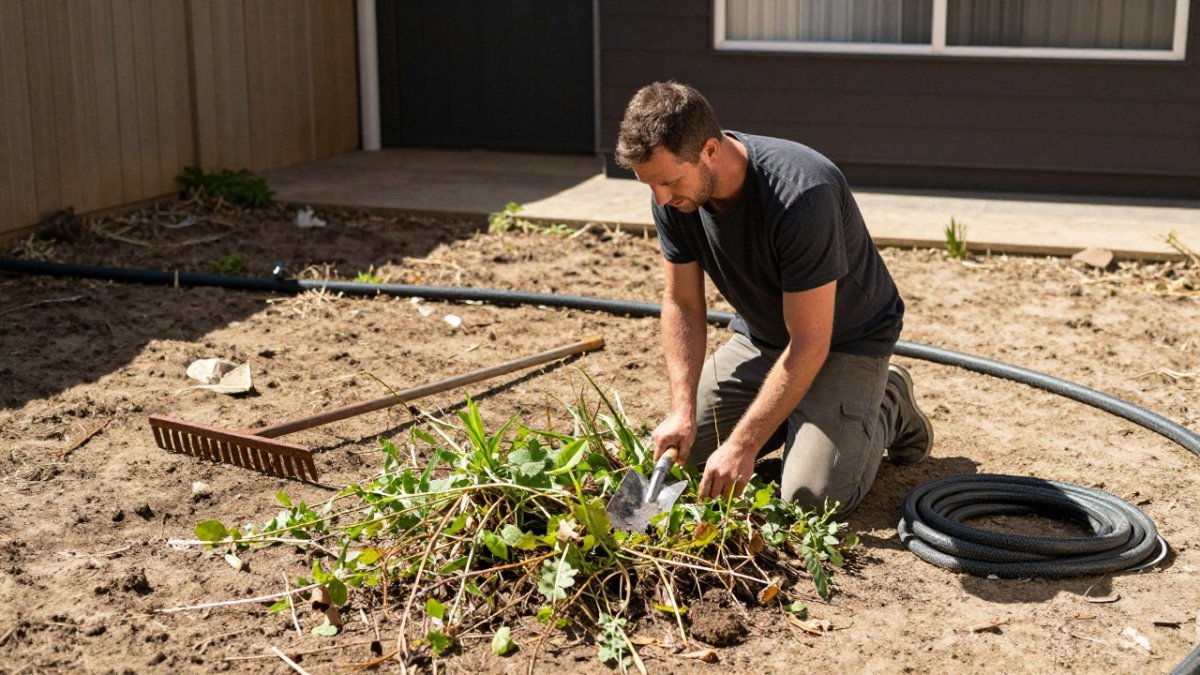
Bare soil is the fastest route to erosion. Cover it quickly.
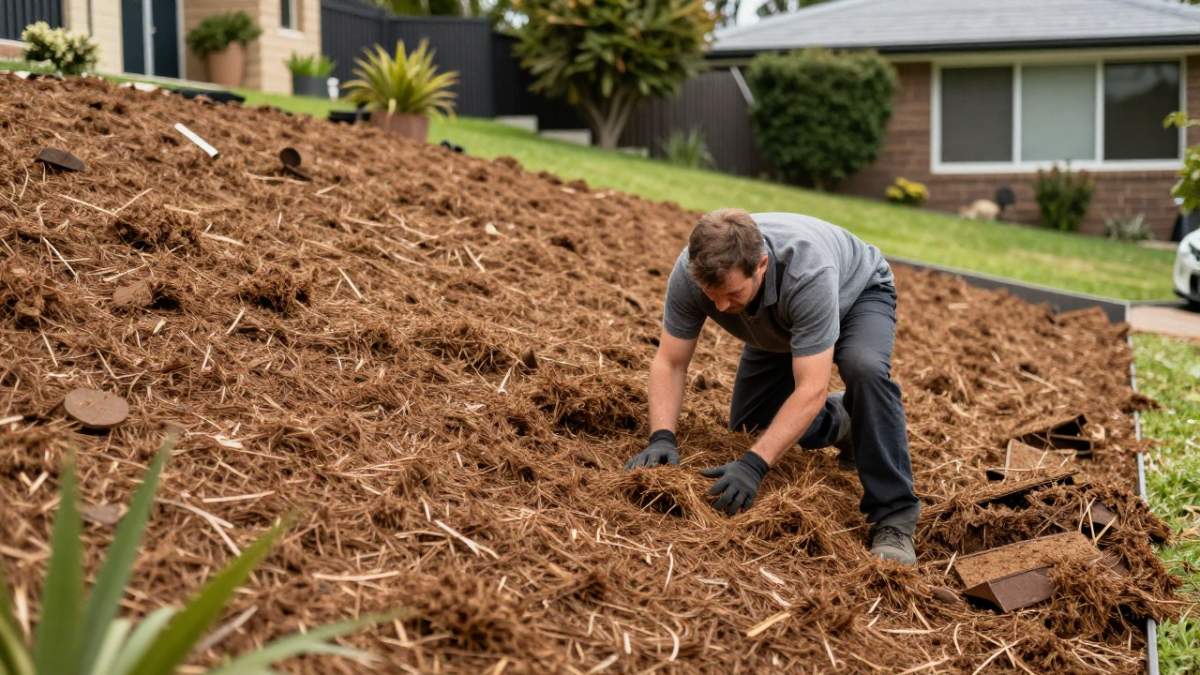
Mulch absorbs rain impact, and turf knits the surface together.
- Spread mulch 75 to 100 millimetres deep over exposed areas.
- Lay turf on flatter sections and on the lower third of the slope.
- Water new cover regularly until roots establish.
Watch out: Turf laid on a steep slope without pegging or proper preparation can slide off the first time heavy rain arrives.
Step 3: Choose Plants for Erosion Control on Slopes
Plants hold soil with their roots and slow water with their leaves. Choose species that root deeply and suit your local conditions.
Native plants are often the best choice because they handle Sydney's wet and dry spells without much help. A good planting mix usually includes:
- Ground covers for quick surface protection
- Mid-level shrubs to break up water flow
- Deep-rooted plants to anchor the slope
Our guide to best native plants for low maintenance Sydney gardens covers suitable species in more detail.
Step 4: Build Drainage Solutions for Sloping Blocks
Drainage is where many slope problems start and stop. Our guide to retaining wall drainage solutions for slopes explains pipe installation and how to prevent hydrostatic pressure failure.
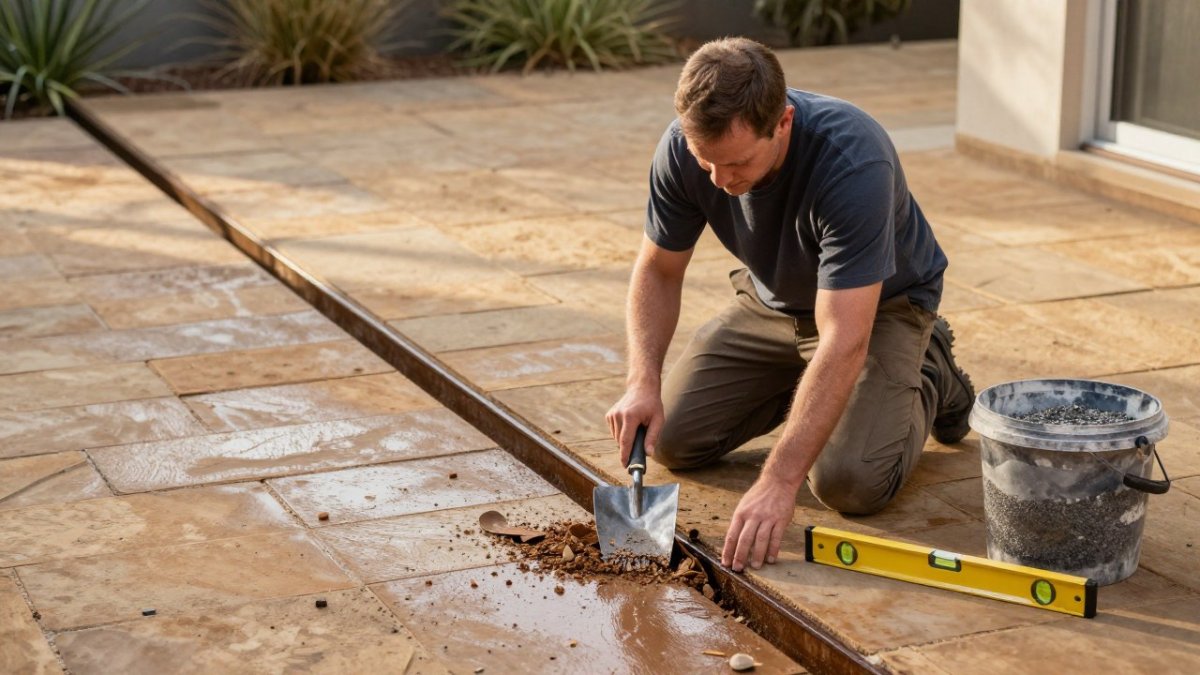
Intercept water above the slope. A catch drain or channel along the top of the slope captures runoff before it reaches exposed soil. It works best when it is continuous, has a gentle fall toward an outlet, and is lined or protected at points where water will move quickly.
Redirect roof and paved runoff. Downpipes that discharge onto a slope, or paved surfaces that drain toward it, often deliver more water in a short burst than the ground can absorb. Connect downpipes to a proper stormwater system where the property allows, and direct driveway and courtyard runoff to a grated drain or pit rather than letting it sheet across the slope.
Relieve groundwater pressure. Where seepage or saturated patches appear, subsurface drainage such as an agricultural-style pipe in gravel can lower water pressure within the slope or behind a wall. Pipes need a continuous fall and a clear outlet, and they need a filter fabric wrap so fine soil does not block them.
Watch out: A retaining wall without drainage behind it can fail once water builds up in the backfill. Weep holes alone are rarely enough on a wet site, so the backfill and any subsurface pipe need to be designed together.
Discharge legally. Stormwater must go to a point the local council or authority accepts, such as the street drainage system, an approved on-site detention arrangement or a designated outlet. Requirements vary with site conditions and location, so confirm them with your local council before you finalise the design.
Know when to get engineering input. Drainage design becomes a specialist task when the slope is tall or already moving, when water is entering it from several directions, when work is close to a boundary or building footing, or when a wall is involved. In those situations, seek advice from a geotechnical or structural engineer rather than relying on general rules of thumb.
FDSS Landscaping Services provides landscape design and construction, from concept and 3D design through to completion. If you want help planning the drainage on a sloping block, you can request a landscaping quote .
The table below summarises the main drainage measures covered in this section and what each one is designed to do.
| Measure | Purpose | Key requirement |
|---|---|---|
| Catch drain above slope | Intercepts runoff before it reaches exposed soil | Continuous, gentle fall to an outlet |
| Downpipe connection | Stops roof water discharging onto the slope | Connect to a proper stormwater system |
| Subsurface pipe in gravel | Relieves groundwater pressure | Continuous fall, clear outlet, filter fabric wrap |
| Retaining wall drainage | Prevents water building up behind the wall | Designed together with backfill and subsurface pipe |
| Legal discharge point | Directs stormwater to an accepted outlet | Confirm requirements with local council |
Step 5: Use Terraces, Contours and Retaining Walls for Sloping Gardens
On steep blocks, breaking the slope into smaller sections slows water and reduces the force on the soil.
- Contour planting follows the natural lines of the slope and traps sediment.
- Terraces create flat planting zones that hold water longer.
- Retaining walls provide structural support where the slope is too steep to hold on its own.
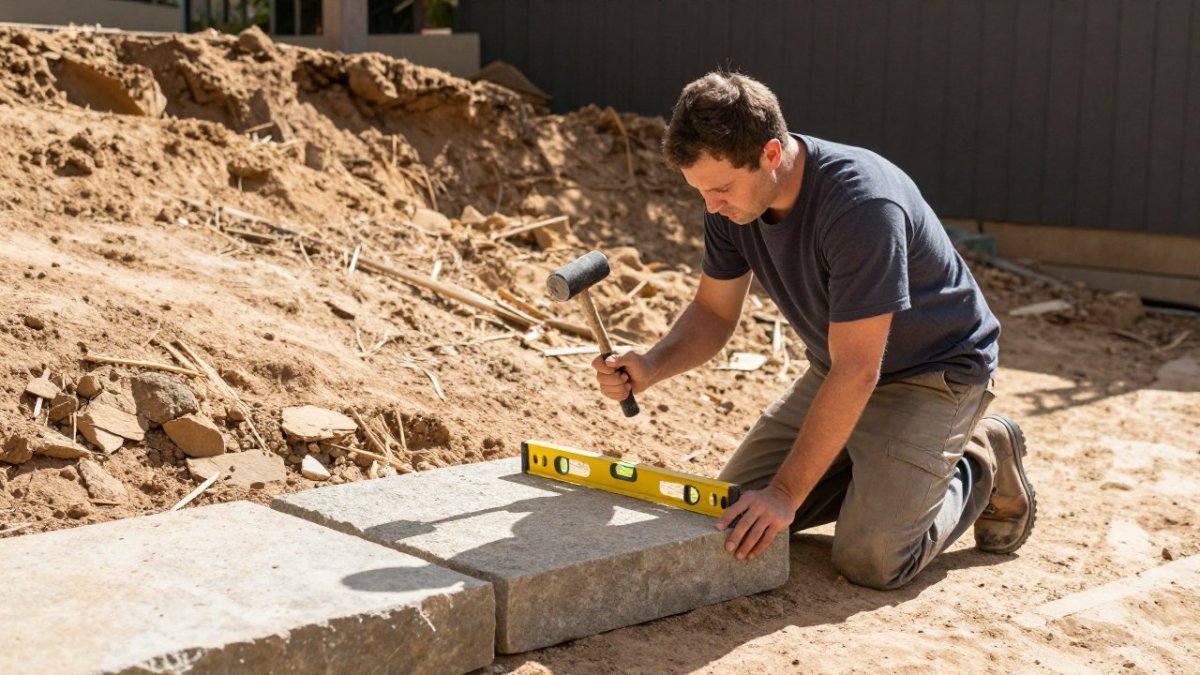
Choosing between a wall and a series of garden beds depends on the gradient, the space you have and your budget. Our comparison of retaining walls versus garden beds for sloped backyards can help you decide. You can also explore our retaining wall construction services.
Step 6: Stabilise Soil After Excavation and Earthworks
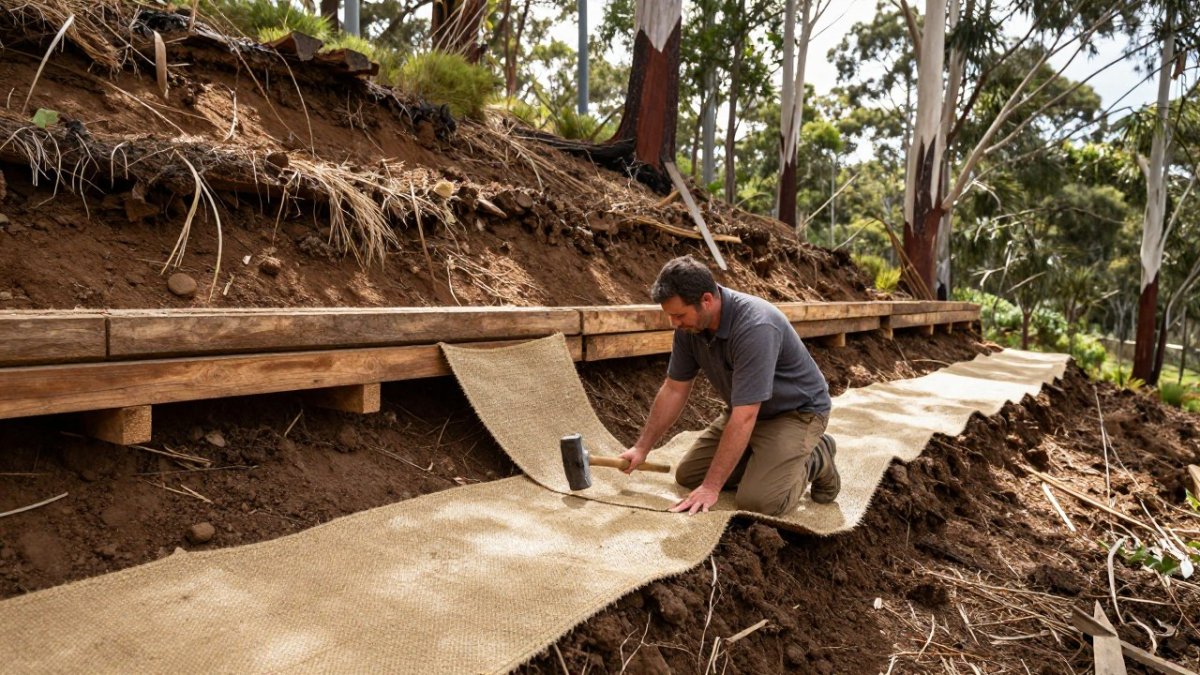
Earthworks are a high-risk time. Once soil is disturbed, it can wash out in a single storm.
Stabilise the ground as soon as digging is finished:
- Cover exposed soil with mulch, geotextile or temporary turf.
- Direct runoff away from fresh cuts.
- Plant or turf the area before the next heavy rain if possible.
Plan the stabilisation step into your project schedule.
Step 7: Maintain Your Slope Over Time
Erosion control is not a one-off job. Plants need time to establish, and mulch breaks down. Check your slope after every heavy storm for new rills, bare patches or blocked drains.
A simple maintenance routine:
- Inspect the slope after heavy rain.
- Top up mulch in thin areas.
- Clear debris from drains and outlets.
- Replace any plants that have died.
Step 8: Know When to Call a Professional
Some signs point to a problem that needs expert help, including:
- Cracks or bulges in a retaining wall
- Soil slumping or moving downhill
- Water pooling against your house foundation
- Large areas of bare soil that keep washing out
Early action is usually cheaper than repairing a failed wall or slope.
Step 9: Book a Site Assessment for Your Sloping Block
Preventing erosion on a steep block is easier when someone has assessed the site properly. FDSS Landscaping Services provides landscape design services for properties across Greater Sydney, with a strong focus on the Hills District and North-West Sydney.
You can request a landscaping quote to start planning your project.
Frequently Asked Questions
How do you stop soil erosion on a steep slope?
Combine three measures: keep the soil covered with plants, mulch or turf, slow and redirect surface water with drainage and contour features, and add structural support such as retaining walls where the gradient is too steep for plants alone. No single measure is enough on a steep block. Covering bare soil quickly is usually the first priority, because raindrop impact and runoff remove the surface layer fastest. The right mix depends on your slope, soil type and rainfall pattern, so a site assessment helps set the priorities.
What plants are best for stabilising a steep garden?
Plants for erosion control on slopes should have dense, fibrous or deep root systems that bind soil and cover the ground quickly. Native groundcovers, grasses and shrubs suited to your local conditions usually perform best, because they establish reliably without heavy watering. Plant in staggered rows following the contour rather than straight up and down the slope, and mulch between young plants while they establish. Establishment takes time, so temporary protection such as mulch or matting is important during the first seasons.
Do retaining walls prevent soil erosion?
Retaining walls hold back soil that would otherwise slide or wash away, and they are useful where a slope is too steep to stabilise with plants alone. A wall on its own does not stop surface erosion, though. Water still needs to be directed away from the wall and the soil behind it, and the area above should be covered with plants or mulch. Walls over a certain height or near buildings usually require engineering and council approval, so check requirements for your site before building.
When should a professional assess erosion on a residential block?
Get a professional assessment if you see cracking or bulging in the ground, soil slumping, repeated washouts after rain, water pooling against a house, or any sign of movement near a structure. Earthworks and excavation on a steep block also justify expert input before work starts. A landscape designer or engineer can check the slope, soil and drainage, and advise when permits or engineering are needed. Requirements depend on your site and your local council, so confirm them before committing to a method.