 how-to
Small Backyard Drainage Solutions for Patios: A Practical Guide
Last Updated: November 6, 2026
Quick Summary
Effective small backyard drainage solutions for patios start with diagnosis: check whether the patio falls the wrong way, the runoff has no outlet, or the subsoil is saturated. Most small patios need two of three fixes, correcting the fall, capturing runoff, and giving it a legal outlet.
- Watch the patio during real rain to see where water pools and what is failing.
- Check fall with a 1.2 m straight edge and a bucket test before buying a drain.
- A channel drain needs its own fall along its length or it becomes a long puddle.
- Flat patios rely on surface grates, shallow channel drains or permeable paving.
- Decide the legal discharge point before choosing any drain.
Table of Contents
- Diagnosing Drainage Problems in Small Backyard Patios
- How to Stop Water Pooling on a Patio
- Channel Drain for Patio Areas: Where a Strip Drain Fits
- Drainage for Patios With No Slope
- Permeable Paving Drainage and Gravel Options
- Directing Runoff Away From the House and Choosing an Outlet
- Maintenance, Troubleshooting and When to Call a Landscaper
- Request a Patio Drainage Assessment and Landscaping Quote
- Frequently Asked Questions
Diagnosing Drainage Problems in Small Backyard Patios
Water pooling on a patio after rain is the clearest sign that small backyard drainage solutions for patios need attention. On Hills District blocks, a paved area that looks fine in dry weather can turn into a shallow pond after a storm.
Diagnosis comes before any fix. Get this step wrong and you will spend money on a drain that solves nothing.
Reading the Water: Pooling, Runoff and Saturation Clues
Where the water sits tells you what is failing. Watch the patio during real rain, not after it.
- Water pooling in the middle: the slab has a low spot or was laid flat.
- Water pooling against the house: the fall runs the wrong way, or there is no fall at all.
- Water sheeting off the edge and sitting beside it: the outlet is blocked or missing.
Saturation is the sneaky one. If the ground stays soggy for days after rain, the subsoil is holding water and no surface drain will fix that alone. You need to deal with the water below as well as the water on top.
How to Stop Water Pooling on a Patio
The direct answer: pooling stops when water leaves the surface faster than it arrives, which means correcting the fall, capturing the runoff, and giving it a legal outlet. Most small patios need two of those three, not all three. The practical question is which two, and that comes down to measuring the fall before you buy a drain.
Measure the fall before you choose a fix
A patio only sheds water if it falls in the right direction at the right rate. On existing paving, you can check this without lifting a paver:
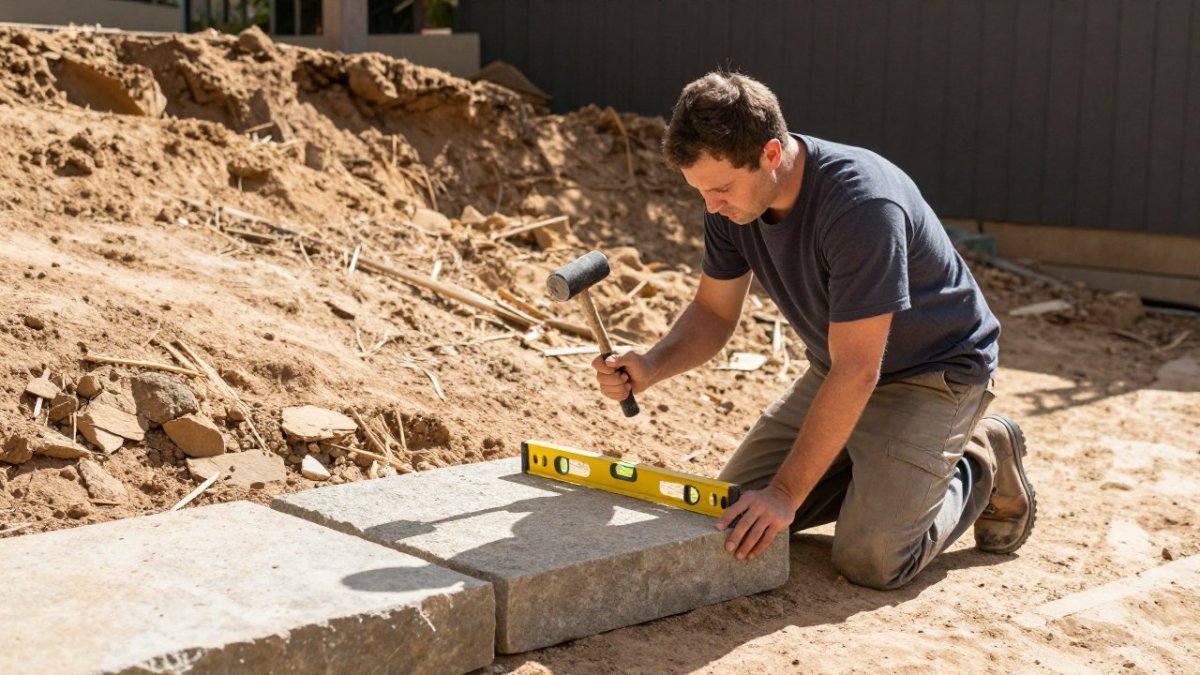
- Lay a straight edge (a 1.2 m level or a straight timber batten) across the patio in several directions.
- Slip a small gap gauge or a set of feeler gauges under the low end and read the gap.
- A gap that is clearly measurable over a 1.2 m straight edge indicates a fall; a very small gap means the surface is effectively flat and may pond.
Then confirm it with water. Pour a bucket across the surface in dry weather and watch where it settles and how fast it clears. A patio that clears within a few minutes is shedding; one that holds a film for hours has a fall problem, not a drain problem.
Identify reverse slope and low spots
A reverse slope is where the paving falls toward the house or toward a wall instead of away. It is the most common cause of water pooling against a sliding door or a step-down, and it is easy to miss because the surface looks level.
Low spots are different. They are local dips in an otherwise correctly falling slab, often from settlement of the base or from pavers laid over an uneven bed. Water finds them every time.
Decide: regrade, re-lay, or drain
The fix follows the diagnosis:
- Reverse slope toward the house: regrading or re-laying the affected paving is usually the correct fix. Adding a channel drain against a wall that water is running toward treats the symptom and can make damp worse.
- Local low spots on sound paving: lift and re-bed the affected pavers, or set a small surface grate at the low point if re-laying is not practical.
- Correct fall but water still sits at an edge: the outlet is the problem, not the slope. A channel drain at the low edge plus a clear discharge point is the answer.
For patios where the paving itself is sound but the levels are wrong, re-laying is often cheaper than adding drains that fight the slope. If the paving needs rebuilding, our paving services cover re-laying and new construction.
When regrading is not enough
If the surrounding ground is higher than the patio, or the patio sits in a hollow between retaining walls, correcting the patio fall alone will not stop water arriving from uphill. In that case the fix is to intercept water before it reaches the paving, a shallow swale, an agi drain along the uphill edge, or regrading the garden bed to divert flow.
Channel Drain for Patio Areas: Where a Strip Drain Fits
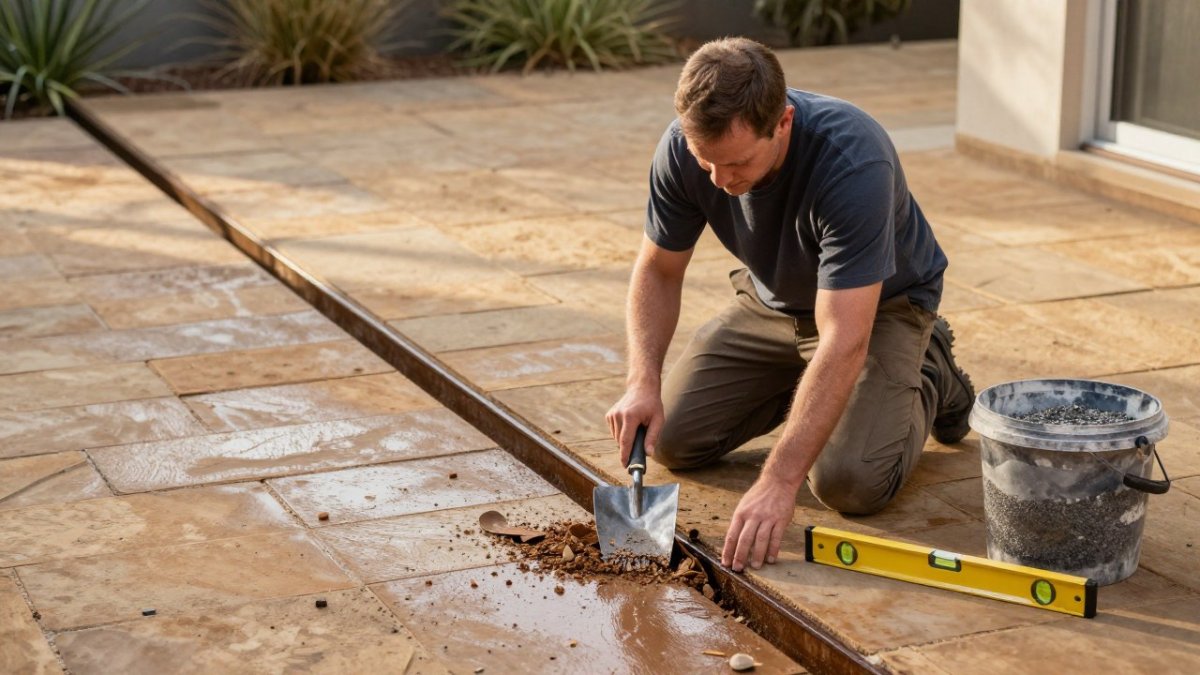
A channel drain for patio areas is a linear strip drain set into the paving, usually along the low edge or where the patio meets the house.
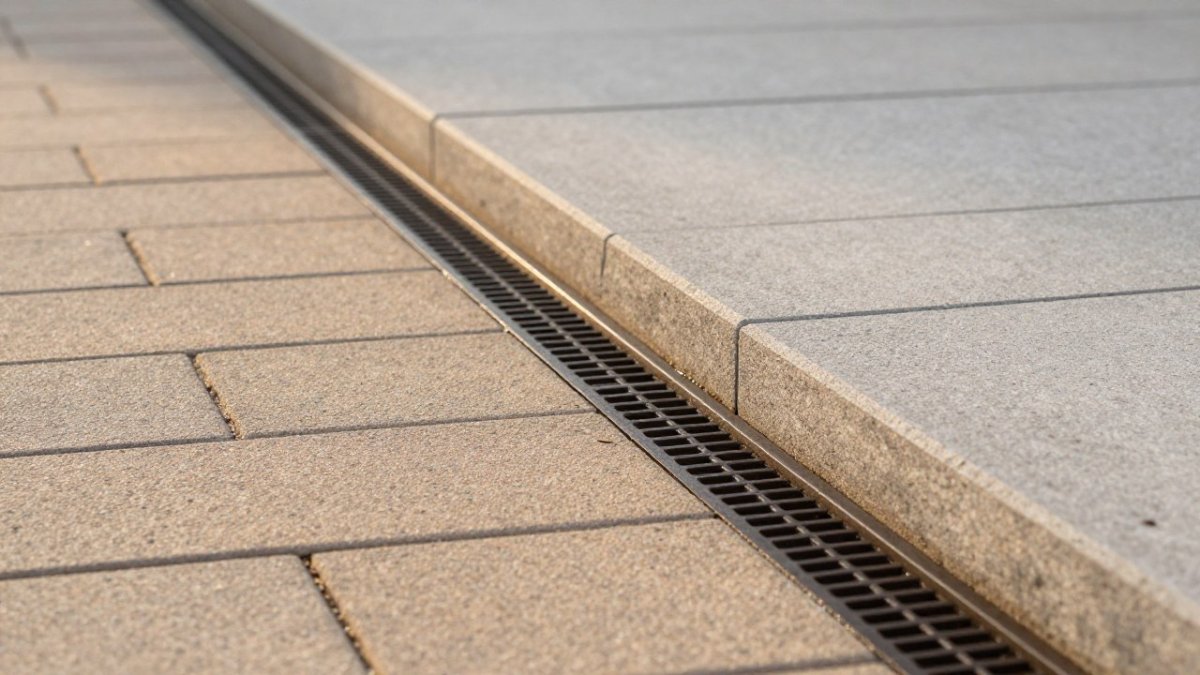
Where it earns its place:
- Along the base of a sliding door or step-down.
- At the low edge of a patio that falls toward the garden.
- Where a patio meets a retaining wall and water collects in the corner.
Where it does not: a channel drain will not fix a saturated subsoil, and it will not help if the outlet is uphill.
Watch out: a strip drain installed with no fall along the channel just becomes a long puddle with a lid on it.
Drainage for Patios With No Slope
Drainage for patios with no slope relies on capturing water at the surface rather than relying on fall. On a flat patio, water has no reason to move, so you have to give it one.
Three approaches suit flat or near-flat areas:
- Surface grates at low points. Small, targeted, and effective if the low point is clear.
- A shallow channel drain with a manufactured fall. Some channel systems can be set to a slight gradient even on a flat slab.
- Permeable paving or open joints. Water passes through the surface instead of running across it.
If the patio is flat and the ground beneath is also flat, the honest answer is that water needs a pump or a connection to a stormwater line.
Permeable Paving Drainage and Gravel Options
Permeable paving drainage lets rainwater pass through the surface and into a prepared base beneath, rather than running off.
The system works as layers:
- Permeable surface: pavers with wide joints, or porous concrete.
- Drainage gravel: crushed gravel or pea gravel bedding that holds and moves water.
- Geotextile fabric: keeps soil from clogging the gravel.
The catch is maintenance. Permeable surfaces clog with dirt, leaves and sand over time, and once they do, they stop draining.
7 benefits of permeable paving for Sydney gardens explains how the layers work and where the approach suits local conditions.
Directing Runoff Away From the House and Choosing an Outlet
Getting water off the patio is half the job. Getting it away from the house, and to a legal outlet, is the other half. This is where a lot of DIY drainage jobs fail, not because the drain was wrong, but because nobody planned where the water would end up.
Plan the discharge point first, not last
Before you choose a drain, decide where the water will go. Work backwards from the outlet:
- Stormwater connection: the preferred option where one is available and accessible. This is the legal point of discharge for most suburban blocks.
- Soakage or infiltration area: a gravel-filled pit or trench in free-draining soil, set well away from buildings and boundaries. It only works if the subsoil actually drains.
- Surface discharge to a garden swale: acceptable where the water can spread and soak away on your own land without pooling or eroding.
If none of these are available, the honest answer is that the patio drainage design needs rethinking before any pipe is laid.
Keep water on your own property
Discharging water onto a neighbour's land can create a legal problem, and it is not a solution. Direct runoff to a point within your boundary that can accept it, a garden bed, a swale, a soakage pit, or a stormwater connection.
On sloping blocks, water naturally moves downhill across boundaries. The aim is to slow it, spread it and infiltrate it on your own land where possible, rather than concentrate it into a pipe that dumps it on the downhill neighbour.
Keep water away from foundations and walls
The other failure mode is redirecting water toward the house. Two rules:
- Surface water should run away from the building, not toward it. If the patio falls toward the house, fix the fall before adding a drain.
- Any drain outlet should discharge at least a metre clear of footings and slab edges, and should not create a damp patch against a wall.
Watch out: a channel drain that collects water at the base of a wall and discharges it into a garden bed right beside the footings has simply moved the damp problem, not solved it.
Check before you connect
Requirements vary by council and site. Before you connect anything to stormwater, check with your local council or a qualified drainage contractor.
On sloping blocks, managing runoff is more involved. Our guide to managing stormwater on a sloping Sydney block covers the options in more detail.
Before choosing a drain, work backwards from where the water will legally end up.
| Outlet option | Best for | Key note |
|---|---|---|
| Stormwater connection | Where one is available and accessible | The legal point of discharge for most suburban blocks |
| Soakage or infiltration area | Free-draining soil | Gravel-filled pit or trench set well away from buildings |
| Surface discharge to a garden swale | Water can spread and soak away on your land | Must not pool or erode |
| Pump to a legal outlet | Gravity cannot reach a connection | Needs power, maintenance and a reliable discharge point |
Maintenance, Troubleshooting and When to Call a Landscaper
Most drainage failures we see are maintenance failures, not design failures. A drain that worked for years stops working because leaves, sediment or roots have blocked it.
The maintenance routine:
- Clear grates and channel drains before each wet season.
- Check the outlet after heavy rain to confirm water is actually leaving.
- Look for sunken paving, which signals a failing base.
Call a landscaper when the problem is structural: failed falls, saturated subsoil, blocked underground lines, or water pooling against the house. If the problem extends beyond the patio into garden beds, our guide to improving drainage on sloped garden beds covers the wider fix.
Request a Patio Drainage Assessment and Landscaping Quote
Small backyard drainage solutions for patios come down to diagnosis, the right fix for your slope and soil, and a legal outlet.
Request a patio drainage assessment and landscaping quote and we will look at the levels, the soil and the outlet before recommending a fix.
Water pooling on a patio rarely fixes itself, and a surface grate thrown at the problem often makes it worse.
Frequently Asked Questions
How do you drain water from a small patio?
Start by finding where the water actually collects and where it can go. For a small patio, the usual options are a channel drain along the low edge, a gravel-filled trench or French drain beside the paving, permeable paving that lets water through the joints, or simply correcting the fall so runoff sheets away from the house. The right choice depends on the patio size, the soil, and whether there is a legal outlet for collected water. A site assessment usually settles it quickly.
Can a patio be drained without a natural slope?
Yes, but it needs help. Where the ground is flat or falls toward the house, you cannot rely on gravity alone, so drainage for patios with no slope typically combines a slight fall built into the paving with a channel drain or strip drain at the low point, connected to a legal outlet or soakwell. The drain does the work the slope cannot. Get the outlet confirmed before any paving is lifted.
Should patio drainage use a channel drain or a soakwell?
They solve different problems. A channel drain for patio edges collects surface runoff and moves it away, while a soakwell lets water soak into the ground. Small patios with a clear low edge often suit a channel drain; sites with sandy, free-draining soil may suit a soakwell. Where runoff is heavy or the soil is clay-heavy, a soakwell alone may not cope. Council requirements also affect where water can discharge, so check before committing.
When should patio drainage be assessed by a landscaper?
Call a landscaper when water pools against the house, when the patio has settled or dropped, when existing drains keep blocking, or when you cannot find a safe place for collected water to go. These are the cases where a wrong fix wastes money. A professional can check levels, soil and outlets, and recommend a solution that suits the space rather than a generic product.