 blog
blog
Best Native Plants for Low Maintenance Sydney Gardens
Table of Contents
- Why Native Plants Suit Sydney Gardens
- Quick Comparison: Best Native Plants for Low Maintenance Sydney Gardens
- Australian Native Plants for Small Gardens
- Native Ground Covers That Suppress Weeds
- Native Plants for Full Sun and Dry Spots
- Low-Maintenance Native Garden Design Principles
- Planting and Ongoing Care: A Simple Maintenance Calendar
- Common Mistakes to Avoid with Native Plants
- Frequently Asked Questions
Last Updated: October 6, 2026
Why Native Plants Suit Sydney Gardens
Choosing the best native plants for low maintenance Sydney gardens starts with one fact: plants that evolved here handle the local climate better than most imports.
Australian native plants are species that occur naturally in Australia and have adapted to local soils, rainfall patterns and wildlife over thousands of years. Once established, most need little more than occasional pruning and a deep water in extended dry periods.
This guide covers the best native plants for low maintenance Sydney gardens, from compact shrubs for small yards to ground covers that crowd out weeds. We also explain how to match plants to your soil, sun and microclimate, and what to plant when.
Quick Comparison: Best Native Plants for Low Maintenance Sydney Gardens
The table below summarises the main options covered so you can compare at a glance before reading the detail.
| Plant | Type | Sun | Mature Size | Best For |
|---|---|---|---|---|
| Lilly Pilly | Shrub or small tree | Full sun to part shade | 2-5 m | Hedging, screening |
| Bottlebrush | Shrub | Full sun | 2-4 m | Flowering colour, birds |
| Banksia | Shrub or small tree | Full sun | 1-6 m by species | Dry spots, coastal |
| Kangaroo Paw | Clumping perennial | Full sun | 0.5-1 m | Striking flowers |
| Lomandra | Grass-like | Sun to shade | 0.5-1 m | Ground cover, slopes |
| Coastal Rosemary | Small shrub | Full sun | 1-1.5 m | Low hedging, coastal |
| Native Grasses | Grass | Full sun | 0.3-1 m | Mass planting, verges |
Australian Native Plants for Small Gardens
Small yards reward careful plant selection, because every plant needs to earn its space. The best Australian native plants for small gardens are compact, slow to outgrow their spot, and useful for more than one purpose, such as screening, colour or habitat. The single biggest mistake in a small garden is planting for the size a plant is now rather than the size it will reach, so the dimensions below matter more than the plant names.
Compact Shrubs and Small Trees
Lilly Pilly (Syzygium species) is the workhorse of the small native garden. It clips neatly into hedges, tolerates most soils and produces glossy leaves with new growth in red and bronze tones.
Banksia brings structure and bird life. Smaller species such as Banksia spinulosa stay around 1-2 m, while larger forms work as feature plants and can reach 4-6 m. They demand well-drained soil, so plant them on a slight mound if your ground holds water.
Kangaroo Paw (Anigozanthos) delivers some of the most striking flowers of any native plant. Clumps sit around 0.5-1 m tall and wide, and they flower best in full sun with sharp drainage.
Hedging and Screening Options
For privacy, Lilly Pilly and Bottlebrush are the two we plant most often. Bottlebrush (Callistemon) tolerates periodic wet soil better than most natives and its brush-like flowers attract birds through spring and summer. Most garden forms reach 2-4 m, so space them about 1.5 m apart for a screen and expect to trim once or twice a year to keep the face dense.
Coastal Rosemary (Westringia) makes a dense, low hedge that handles wind and salt. At roughly 1-1.5 m, it suits a low border or a front-yard screen, and it can be kept lower with regular light trimming. Space plants around 60-80 cm apart for a tight formal line.
Growth Rates at a Glance
Growth rate decides how often you will be pruning and how quickly a screen will do its job. As a general guide:
- Fast: Bottlebrush and most Lilly Pilly forms, good for quick screening, but they need annual trimming to stay tidy.
- Moderate: Westringia and Lomandra, steady, predictable, low fuss.
- Slow: Banksia, takes years to reach full size, but needs the least ongoing pruning.
If you are unsure how a plant will sit against a fence, a driveway or a retaining wall on your block, it is worth having the layout checked before planting. Our landscape design service maps mature sizes and spacing so the garden still works in ten years, not just on planting day.
Native Ground Covers That Suppress Weeds
Native ground covers are the cheapest weed control you can install: dense planting shades the soil, so weed seeds struggle to germinate. Lomandra is the standout.
Native grasses such as kangaroo grass and tussock grasses work well for mass planting on verges and embankments. They need a hard cutback once a year, usually in late winter, to stay tidy.
For quick coverage on slopes, combine ground covers with mass planting of the same species. Repeated planting looks deliberate, spreads maintenance evenly and creates a stronger visual statement than a scattered mix.
Native Plants for Full Sun and Dry Spots
Native plants for full sun and dry spots share one requirement: drainage. Banksias, kangaroo paws and most westringias rot in waterlogged soil long before drought ever troubles them. If your site is heavy clay, mound the bed or install drainage before planting.
The most drought tolerant choices include:
- Banksia for structure and bird-attracting flowers
- Kangaroo Paw for colour in hot, open positions
- Coastal Rosemary for low, wind-hardy hedging
- Native grasses for mass planting where mowing is impractical
Water new plantings through their first summer, then taper off. Established plants from these groups typically survive on rainfall alone, with a deep soak only during prolonged dry spells. That is the core of water-wise gardening: get them through establishment, then let them fend for themselves.
Low-Maintenance Native Garden Design Principles
A low-maintenance native garden is not an unplanned one. Good design reduces work later: the right plant in the right spot needs less water, less pruning and fewer replacements. This is where landscape design earns its keep.
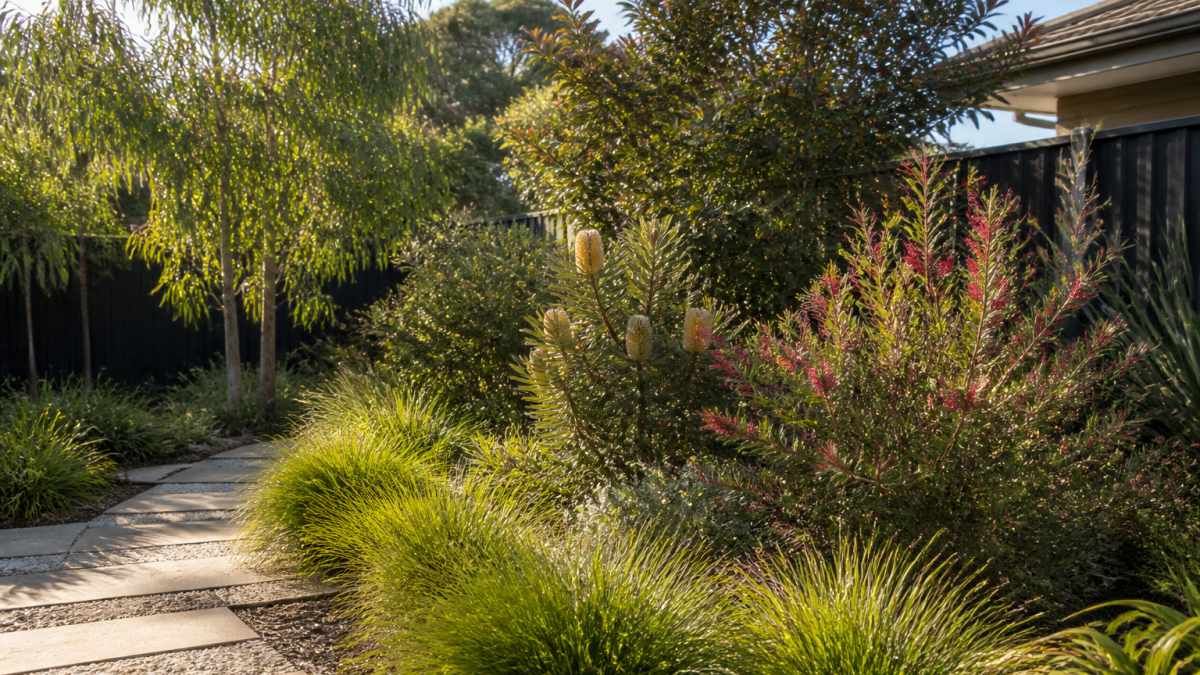
Layered Planting for Texture and Habitat
Think in three layers: ground covers, mid-sized shrubs, and a small tree or tall shrub. Each layer does a job. Ground covers suppress weeds, shrubs provide flowers and screening, and the upper layer gives shade and habitat. Layering also hides bare soil, which is where most weed problems begin.
A simple low-care combination for a sunny bed might be:
- Back layer: a small eucalypt or a Lilly Pilly standard for height and screening.
- Mid layer: a Bottlebrush for flowering colour and bird life, with a Banksia for structure.
- Front layer: Lomandra 'Tanika' as a repeating ground cover, edged with Coastal Rosemary for a low border.
Repeat the same front-layer species along the bed rather than mixing many. Repetition reads as deliberate design, spreads maintenance evenly, and makes the garden look established faster.
Matching Plants to Soil, Sun and Microclimate
Walk your garden at different times of day before choosing plants. Note where sun lands, where shade sits, where water pools and where wind hits. Then match:
- Full sun, sandy soil: Banksia, Kangaroo Paw, Coastal Rosemary
- Part shade, clay soil: Lomandra, Lilly Pilly
- Exposed, windy sites: Coastal Rosemary, native grasses
- Damp lower corners: Bottlebrush, which handles wet feet better than most natives
Soil type matters as much as sun. Heavy clay holds water and can drown banksias and kangaroo paws, so mound the bed or improve drainage before planting. Sandy soil drains fast and dries out quickly, so it suits the drought-hardy group but benefits from added organic matter to hold a little moisture while plants establish.
Spacing and Structure
Spacing is where most home plantings go wrong. Planting at the final mature width looks sparse for the first year but avoids the overcrowding that forces hard pruning later. As a rule of thumb, set plants at roughly their mature width apart, then fill the gaps with fast-growing ground covers or annuals for the first season. If you are planting against a fence, a retaining wall or a paved edge, leave enough room for the plant to reach its full spread without pressing on the structure.
If you would rather not work through soil, sun and spacing yourself, our team can map the layers, choose species that suit your block and set out the planting before anything goes in the ground.
Planting and Ongoing Care: A Simple Maintenance Calendar
Native gardens need less work than most people expect, but the work needs to happen at the right time. Here is the calendar we use on our own projects.
| Season | Task | Frequency |
|---|---|---|
| Spring | Deep water new plantings, light tip prune | Weekly for new plants |
| Summer | Deep soak established plants in dry spells | Fortnightly if no rain |
| Autumn | Best planting window; add mulch | Once |
| Winter | Hard cutback of native grasses, structural pruning | Once |
A few rules matter more than any calendar. Mulch to about 7 cm, keeping it clear of stems. Avoid phosphorus-rich fertilisers, because many natives, especially banksias and grevilleas, are sensitive to it. And water deeply but rarely, which pushes roots down where they belong.
Common Mistakes to Avoid with Native Plants
The biggest mistake is treating natives like exotics. They are not. Feed them the way you would feed a rose and you will shorten their lives.
Other errors we see often:
- Planting into poor drainage. Most native losses come from wet feet, not drought.
- Over-fertilising. Use low-phosphorus products, or none at all in good soil.
- Hard pruning into old wood. Most natives will not reshoot from bare stems.
- Planting too close together. Check mature size and spacing before you dig.
- Ignoring local provenance. Plants grown from local seed stock generally establish better and support local wildlife.
If you would rather not work through all of this yourself, our landscape design service covers plant selection, layout and 3D design before a single plant goes in the ground.
Getting plant selection right is the difference between a garden that thrives on rainfall and one that demands constant attention. FDSS Landscaping Services designs and builds native gardens across the Hills District and North-West Sydney, from concept and 3D design through construction and completion, including turf installation, paving and garden construction.
Frequently Asked Questions
What are the best Australian native plants for small gardens?
For small gardens, choose compact forms such as dwarf lilly pilly, westringia and kangaroo paw. Kangaroo paw (Anigozanthos) gives striking flowers in full sun, while lilly pilly can be clipped as a hedge. Lomandra and native grasses fill gaps without spreading aggressively. Check the mature size on the label, because many natives sold as small shrubs can reach 2 to 3 metres. These native plants for Sydney gardens stay manageable with light pruning once a year.
Which native ground covers help reduce weeding?
Dense ground covers form a living mulch that shades the soil and limits weed seed germination. Plant them at the spacing recommended for the species, usually 50 to 100 centimetres apart, and water regularly until established. A layer of coarse mulch around new plantings further reduces weeds. Once native ground covers knit together, maintenance drops to occasional trimming and spot weeding.
How do I choose native plants for different soil and light conditions?
Start by checking how much sun each part of the garden receives and whether the soil is sandy, clay or well-drained. Full-sun spots suit banksia, grevillea and kangaroo paw, while shaded areas are better with lomandra or lilly pilly. Most natives prefer well-drained soil, so heavy clay may need gypsum or raised beds. Group plants with similar needs together, and confirm local suitability with your council or a landscaping professional before planting.
How can I design a native garden that needs less ongoing maintenance?
Plan a layered native garden design: ground covers at the front, mid-height shrubs behind and a small tree or tall shrub at the back. Choose species with similar water and sun needs, plant them at their mature spacing, and mulch well. Water deeply during the first year to establish roots, then reduce to minimal watering. Prune lightly after flowering rather than hard cutting. This approach suits low-maintenance gardens across the Hills District and wider Sydney.