 how-to
Commercial Landscaping Sydney: A 2026 Planning Guide
Table of Contents
- Commercial Landscaping Sydney: What a Project Actually Involves
- How Commercial Landscape Design Shapes the Whole Build
- Commercial Landscape Construction: From Site Works to Handover
- Commercial Drainage Solutions That Protect the Finished Site
- Hard and Soft Landscaping: Where the Budget Actually Sits
- Getting a Commercial Landscaping Quote You Can Compare
- Maintenance, Approvals and What to Check Before You Commit
- Conclusion: Start With a Site Assessment, Not a Price
- Frequently Asked Questions
Last Updated: October 13, 2026
Commercial Landscaping Sydney: What a Project Actually Involves
Commercial landscaping Sydney is the design, construction and ongoing maintenance of outdoor areas for commercial, industrial, government and multi-residential sites.
The scope is broader than most people expect. A commercial landscape project typically includes site assessment, landscape design, excavation and site works, retaining walls, paving, concreting, drainage, turf installation, planting and outdoor living structures.
Below, we break down each stage so you can plan, budget and compare quotes with confidence. The process matters more than the price tag, because a cheap quote that skips site works will cost you far more later.
How Commercial Landscape Design Shapes the Whole Build
Commercial landscape design is the stage that determines whether the finished site works in practice, not just on paper. Get it right and construction runs smoothly. Rush it and every later stage inherits the problem.
Design starts with understanding how the site will actually be used. A retail frontage, a warehouse hardstand, a school playground and a strata courtyard all have different functional demands, and the design has to answer them before anything is built.
Site assessment and survey: what gets checked first
A site assessment records levels, drainage patterns, soil conditions, existing services, access points and any easements or constraints. This is where we identify what can be built where, and what needs engineering input before construction begins.
Requirements vary depending on the site, the council and the relevant authority. We do not assume a standard approach applies, because it rarely does.
Concept design and 3D visualisation
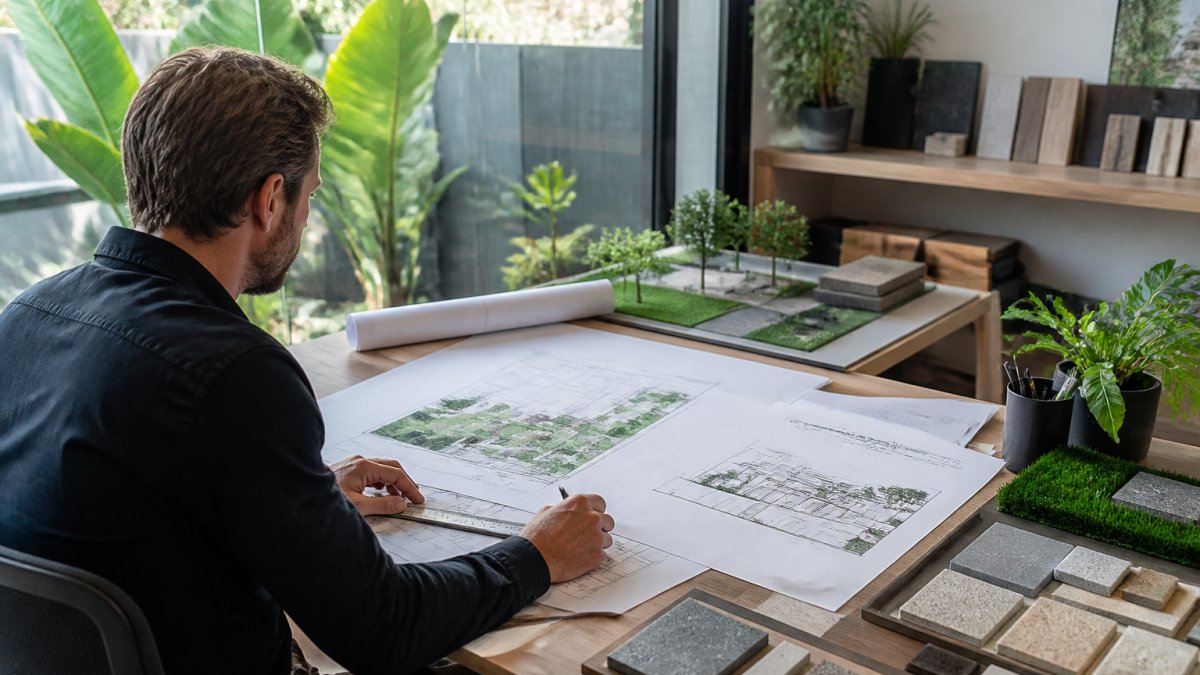
Concept design translates the brief into layouts, materials and planting. 3D visualisation lets you see the finished outdoor space before a single paver is laid, which makes approval and sign-off far easier for builders, developers and property owners.
Commercial Landscape Construction: From Site Works to Handover
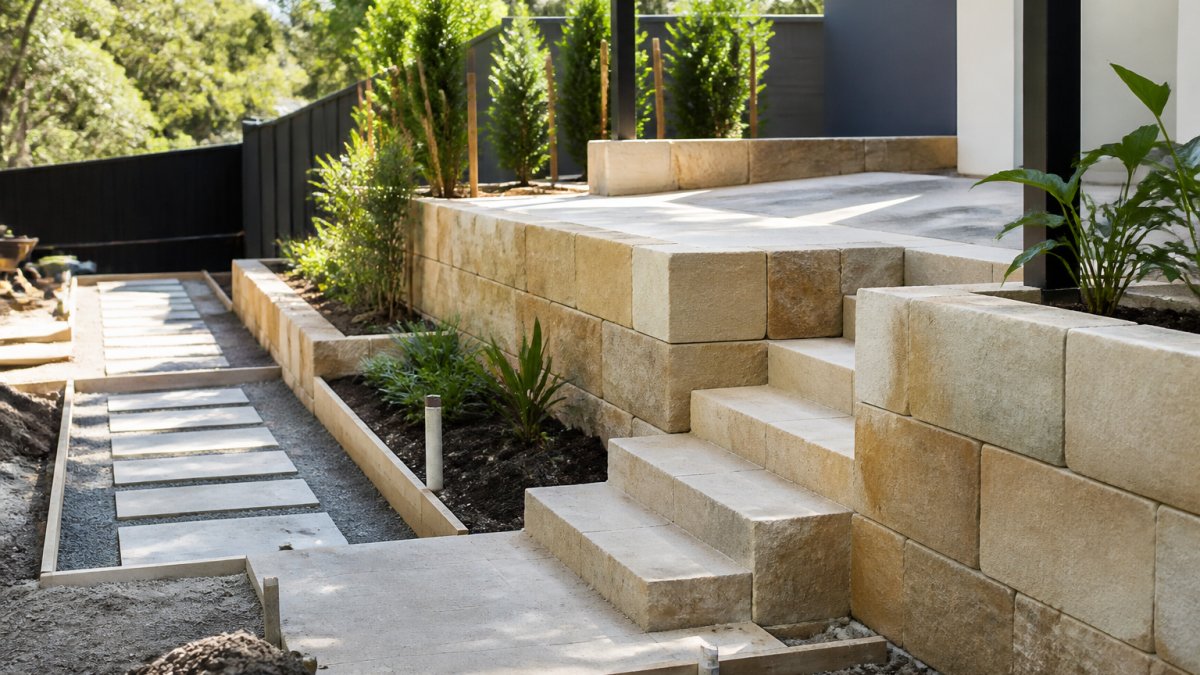
Commercial landscape construction turns the approved design into a finished site. It covers excavation, site preparation, retaining walls, paving, concreting, drainage, turf and planting, delivered in a sequence that protects earlier work.
Sequencing is where inexperienced contractors come unstuck. Drainage and services go in before paving. Retaining structures go in before the levels above them are finished. Get the order wrong and you are pulling up new work to fix it.
A common mistake is treating landscape construction as the last trade on site, squeezed in after the builder has gone. In practice, early involvement prevents clashes with services, levels and access.
Commercial Drainage Solutions That Protect the Finished Site
Commercial drainage solutions are the difference between a landscape that lasts and one that fails after the first heavy storm. Water that has nowhere to go will find the weakest point: paving, retaining walls, turf or building footings.
Effective drainage combines surface grading, subsurface systems, agi drains, pits and connection to the appropriate stormwater point. On larger sites, this often needs engineering input, and requirements depend on the site, the council and the relevant authority.
The thing nobody tells you about drainage is that it is almost invisible once finished. That makes it the easiest item to cut from a quote and the most expensive to retrofit.
Hard and Soft Landscaping: Where the Budget Actually Sits
Hard and soft landscaping are the two halves of every outdoor build. Hard landscaping covers the built elements: paving, concreting, retaining walls, steps, edging and structures. Soft landscaping covers the living elements: turf, garden beds, planting and soil preparation.
Budget tends to concentrate in hard landscaping, because excavation, retaining walls and paving carry the heaviest labour and material costs. Soft landscaping is usually the smaller share, though it is what most people notice first.
| Element | Type | What drives the cost |
|---|---|---|
| Retaining walls | Hard | Height, access, engineering and material |
| Paving and concreting | Hard | Area, base preparation and finish |
| Drainage and site works | Hard | Site levels, soil and connection points |
| Turf installation | Soft | Area, soil prep and turf variety |
| Planting and garden beds | Soft | Plant selection, density and soil condition |
Pricing depends on the site, the scope and the materials specified, so we provide a quote based on your actual project rather than a generic rate. For current pricing, request a quote from FDSS Landscaping Services.
Getting a Commercial Landscaping Quote You Can Compare
A commercial landscaping quote is only useful if it lets you compare like with like. The cheapest number is rarely the cheapest project, because quotes that omit site works, drainage or soil preparation are not quoting the same job.
The most reliable approach is to issue a clear brief and ask every tenderer to respond to the same scope. That way, differences in price reflect differences in approach, not differences in what was included.
What a complete quote should cover
When you review quotes, check that each one addresses:
- Site assessment and any required survey or engineering input
- Excavation, site preparation and spoil removal
- Drainage scope, including where water connects and who is responsible for the connection
- Retaining structures and their engineering basis
- Paving, concreting and base preparation
- Soil preparation, turf and planting
- Maintenance after handover and any defects period
- Approvals, and who is responsible for lodging them
- Program, staging and site access arrangements
- Insurance, including public liability and workers compensation
- Warranties on materials and workmanship
- Exclusions, provisional sums and how variations are priced
If a quote is silent on any of these, ask. A clear answer tells you more about the contractor than the price does.
Comparing submissions on more than price
Price is one column. The others matter just as much:
| What to compare | Why it matters |
|---|---|
| Scope completeness | A low price with missing drainage or soil prep is not comparable |
| Program and staging | Delays to a builder's handover have knock-on costs |
| Site access and logistics | Tight sites, shared access and occupied premises change the approach |
| Insurance and qualifications | Confirm cover and relevant trade experience before work starts |
| References and similar projects | Ask for examples of comparable sites, not just any project |
| Maintenance and defects | Clarify what is included after handover and for how long |
| Exclusions and provisional sums | These are where budgets blow out if not understood upfront |
Questions worth asking every tenderer
- Who is your site supervisor, and how often will they be on site?
- How do you sequence landscape works with the builder and other trades?
- What happens if levels or services differ from the drawings?
- How are variations documented and approved?
- What does your defects process look like after practical completion?
A tenderer who answers these clearly and in writing is usually the safer choice, even if their number is not the lowest. Pricing depends on the site, the scope and the materials specified, so FDSS Landscaping Services provides a quote based on your actual project rather than a generic rate. For current pricing, request a quote from FDSS Landscaping Services.
Maintenance, Approvals and What to Check Before You Commit
Approvals and maintenance are the two items most often left until too late. Both are far easier to handle when they are planned into the project from the start, and both have a direct bearing on how the finished site performs over its life.
Approvals: what typically triggers extra requirements
Approval requirements depend on the site and the relevant council or authority, and they vary from one project to the next. Rather than assume a standard approach applies, it is worth understanding the common triggers so you can raise them early with your contractor and, where needed, your certifier or planner.
Typical triggers include:
- Retaining walls above certain heights, which may require engineering certification and, in some cases, development approval
- Changes to stormwater discharge, connection points or on-site detention
- Works near easements, services or drainage lines
- Alterations to public land, footpaths or road reserves
- Tree removal or works within a protected zone
- Accessibility requirements for public-facing or commercial entries
A practical sequence is to confirm the site constraints first, then check what the relevant council requires, then design to those requirements rather than retrofitting compliance later. On larger or more complex sites, a town planner or certifier may need to be involved.
Maintenance: measuring what actually matters
A maintenance program keeps the finished landscape performing, but "regular maintenance" is not a useful specification. It helps to define what is being maintained and how success is measured.
Practical measures include:
- Plant survival and establishment rates over the first 12 to 24 months
- Irrigation performance and water use against the design intent
- Turf health, mowing frequency and weed pressure
- Drainage function after heavy rainfall
- Hard surface condition, including paving movement, joint integrity and retaining wall performance
- Response times for defect resolution during any defects period
Whole-of-life cost matters more than the initial maintenance rate.
For property owners and strata managers, it also helps to clarify who is responsible for what after handover: the contractor during the defects period, and the ongoing maintenance provider thereafter.
Conclusion: Start With a Site Assessment, Not a Price
Every commercial landscape project carries risk: a quote that looks competitive but omits site works, drainage or soil preparation, and a finished site that fails within a few seasons. The way to avoid it is to start with a proper site assessment rather than a price.
FDSS Landscaping Services provides end-to-end landscape design and construction across Greater Sydney, including Castle Hill, Baulkham Hills, Bella Vista, Norwest, Kellyville, North Kellyville, Rouse Hill, Box Hill, Glenhaven, The Ponds and surrounding areas. Our integrated design-and-build approach keeps one experienced team with you from concept and 3D design through construction to completion.
Get started with FDSS Landscaping Services and request a landscaping quote for your site.
Frequently Asked Questions
What should a commercial landscaping project include?
A complete commercial landscaping project usually covers site assessment, concept and 3D design, excavation and site works, hard landscaping such as paving and retaining walls, soft landscaping including turf and planting, drainage, and an ongoing maintenance program. On commercial properties the scope is often staged so landscaping follows the main build without holding up practical completion. It helps to agree the full scope in writing before work starts, including who handles irrigation, lighting and any fencing, so nothing is left for a separate trade to finish later.
How do I get a commercial landscaping quote that is actually comparable?
Ask every provider to quote against the same drawings, scope notes and site access conditions. A useful commercial landscaping quote itemises excavation, drainage, hard and soft landscaping, materials, disposal and any provisional sums rather than giving one lump figure. Confirm what is excluded, whether council or authority approvals are included, and how variations are priced. Because pricing depends on site conditions, scope and program, request a quote based on your actual site rather than comparing broad estimates from different providers.
How long does a commercial landscaping project take?
Timelines depend on site area, access, the amount of excavation and drainage, and whether the work is staged around a building program. A small commercial courtyard can be completed in a matter of weeks, while larger sites with retaining walls, paving and extensive planting run for several months. Weather and material lead times also affect the program. A realistic schedule should be set out in the quote or contract, with clear milestones, so you can coordinate landscaping with the rest of the development.
Do I need approval for landscaping on a commercial site?
It depends on the site and the relevant council or authority. Some works, such as retaining walls over a certain height, significant earthworks or changes near drainage and easements, may need approval or engineering input, while planting and turf generally do not. Requirements vary between councils and are assessed case by case. Before committing to a design, confirm what applies to your property with the relevant council or a qualified consultant, and factor any approval time into your program.